
Like most humans, I have actively avoided contemplating my own demise. Until recently.
Luckily, Western society is in complete denial about death so we can cheerily stand around the water cooler chatting about the unbridled pleasures of salary sacrificing.
Maybe in a very subtle unconscious way, we don’t dwell on dying because religion has convinced us we have options. Catholics believe you can cool off in purgatory until your sinful souls were purified enough to bugger off to Heaven.
Other mystical religions hedge their bets on reincarnation. But there is a good chance you’ll come back as plankton and not a Golden Retriever.
But the reason we don’t marinate on our mortality isn’t entirely our fault.
Our brains are wired to ignore that suffocating and crippling feeling that one day we will all become fertiliser.
Researchers at the Bar Ilan University in Israel found our brain refuses to accept that death is related to us.
“We have this primal mechanism that means when the brain gets information that links self to death, something tells us it’s not reliable, so we shouldn’t believe it,” Yair Dor-Ziderman told the Guardian.
Imagine if scientists switched off that part of our noggin that was shielding us from pondering our death? How would humans react? That’s a reality show I would tune into.
So naturally, when I recently found myself surrounded by a strikingly handsome team of medicos, attaching various devices to my chest and arms like a Formula One pit team, I wasn’t contemplating my expiration date.
I mean, there was the odd hint something was amiss.
Despite the fact, close to 100 people were moaning and groaning in the ED, when a nurse checked my pulsed she urgently signalled me to follow her as if one of my limbs had suddenly fallen off.
I can’t recall when or how it was mentioned that I might’ve had a mild heart attack but I was suddenly enveloped by one predominant emotion. Fear.
And as irrational as this is going to sound, there is nothing more sobering and jarring than that unpleasant realisation that you really could die at any moment.
While my “near-death experience” may have only lasted five to 10 minutes, it must’ve been chaotically unnerving because I vaguely remember asking one of the nurses if she knew of any reasonably priced funeral directors.
It wasn’t until the next day when a cardiologist ebulliently informed me I had nothing to worry about as it was just myocarditis.
“Given my age, things start to go wrong,” he told me. I almost expected him to pass me an end-of-life pamphlet.
Myocarditis is inflammation of the heart muscle that is usually caused by a mild heart attack or viral infection. It sounds terrifying, but it’s pretty common.
The disease sounds like the name of an ancient Greek philosopher who believed living in wine a barrel would lead to an enlightened form of tranquillity.
Most folk will recover and go on to lead normal lives before dying of something else.
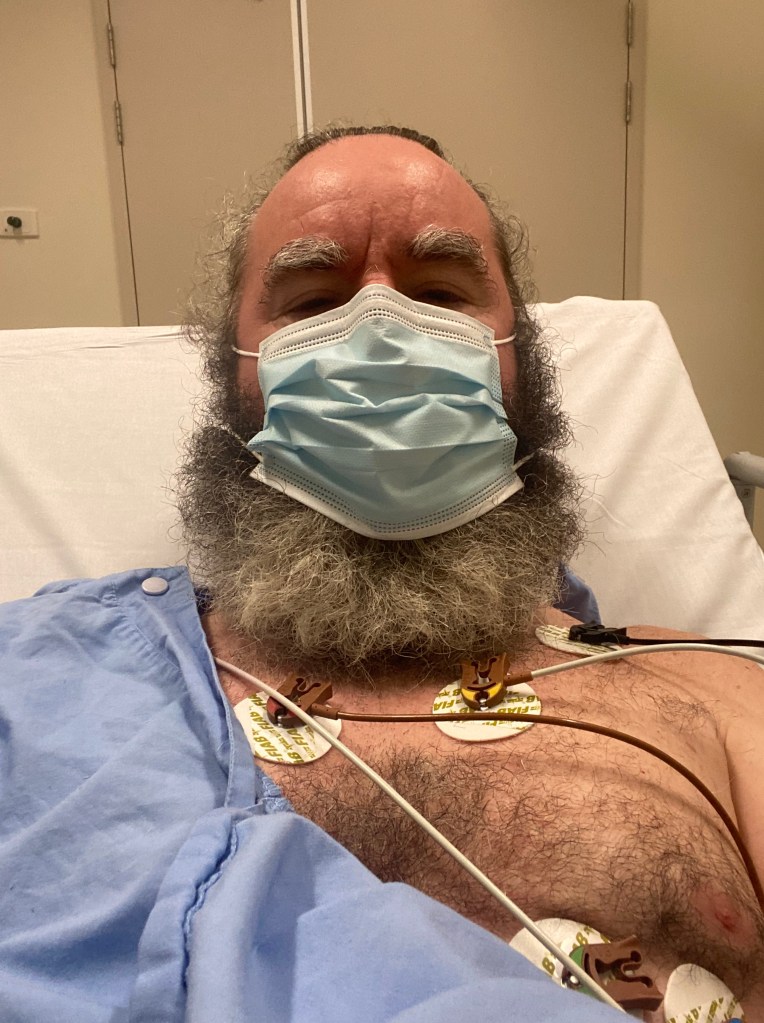
Myocarditis can come on suddenly. I had only been in Bali a few hours when I felt a jolt in my chest like I’d just been whacked by an angry Black Swan. Given I have all the alacrity of an Arabian camel in the water, I just assumed I tweaked a muscle when I dog-paddled the six or so metres to reach my Bintang.
The following days I sweated more than usual and found myself getting overtaken by blind, 90-year-old hawkers with wooden carts while climbing a gentle incline.
I was in Bali. You always feel like you are moments away from purging something unsavoury from the body. And the discomfort was in the right side of my chest so I immediately ruled out any heart attack.
I was naïve and dumb to ignore the pleas of my family to seek medical help.
(Even though I had travel insurance I still had images of a MASH-like hospital in Bali where I’d be given a blood transfusion from a couple of monkeys).
I can’t confess to any profound revelatory moments during the couple of minutes when I thought I was exiting the stage right, other than my obvious cowardliness.
But over the coming days, it was difficult to sidestep the obvious uncomfortable question. I am going to die one day. (Anyone under 49 reading this can go back to bingeing whatever it is your bingeing)
For the rest of us old farts, that’s a pretty damn, chunky thing to chomp down on.
Then in one of those wonderful synchronised moments, I stumbled across Brigid Delaney’s book Reasons Not to Worry: How to be Stoic in chaotic times.
Delaney brilliantly outlines how we can achieve lingering tranquillity by applying the ancient philosophy of Stoicism.
Delaney is a masterful storyteller, whose writing is brimming with wit, profundity, insight and vulnerability.

The Stoics believed we have control over three things: our character, our actions and reactions and how we treat others. Getting bogged down in anything is a waste of energy.
There was a simple practicality to it that I found alluring. It didn’t feel like some cheap elixir.
Yeah, it’s obvious but try maintaining it.
More importantly, the Stoics felt we desperately needed to remind ourselves over our morning coffee that we all have an end date.
They make a valid point.
The Stoics were painfully bleak in their philosophy on life but there is a rich beauty to their bluntness. I had recently converted to Schopenhauer’s “life is suffering” model, which is the equivalent of being stuck in Dry July for an eternity.
The Stoics avoid suffering at all costs and want us to enjoy the fucken hell out of our time on earth.
Whether or not I was oversensitive and receptive to the Stoic philosophy because a ridiculously dishy doctor mumbled something about a mild heart issue, I didn’t care.
I was hooked.
In the first few weeks, I haplessly tried to integrate some of the Stoic ways into the everdayness of my life. It doesn’t help that we inhabit a world where social media platforms encourage hostile behaviour.
I slowly stopped reacting whether it be in texts, online or in person. Oh, I fell off the wagon but for the majority of the time, I took my finger off the trigger.
I begin to feel gentle trickles of calmness entering my mind. All the well-rehearsed arguments with friends, family and loved ones began to retreat.
If I remained “stoic”, a hushed ceasefire existed.
My relationship with Stoicism isn’t yet instagrammable. I have a long way to go because I’m just starting to dive deep into the ancient philosophy of Marcus Aurelius and his Roman mates. But in a short time, I’ve grown deeply fond of Stoicism.
Oh, if I haven’t told you to fuck off recently, don’t take it personally.
And sorry about this next bit. But we are all going to die so we might as well try to enjoy ourselves.


 What's Happening Here
Leave a reply to thedelicatewhitenoiseofsaturdayafternoons Cancel reply